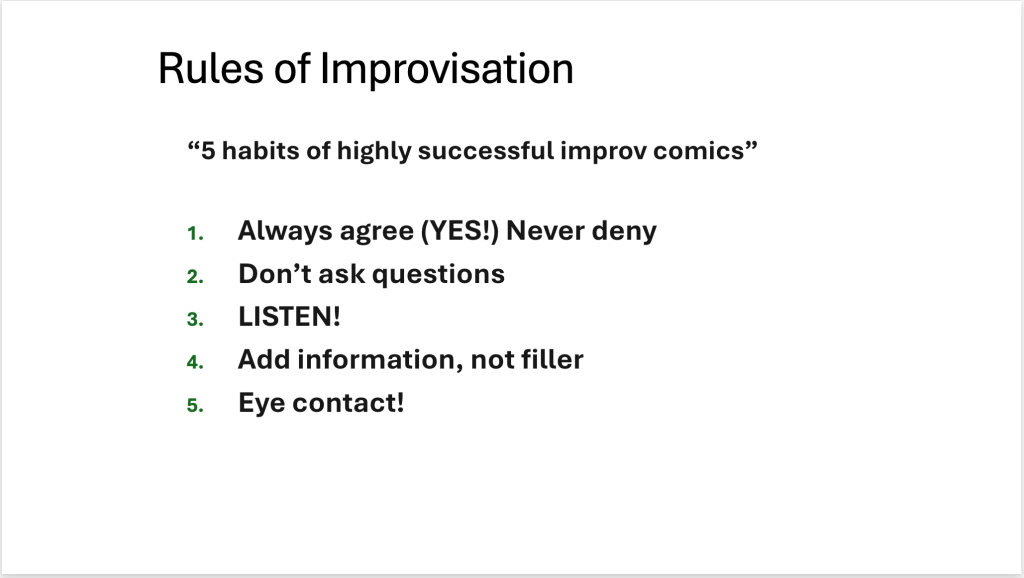
I recently shared my list of the 5 Habits of Highly Successful Improv Comics [below]. It’s what I teach execs around the world who want to improvise. You too can learn too. With practice, you too can be an improviser! Maybe not a comic, but, hey, one step at a time.
1) Think “Yes, and” Before You Speak.
You don’t have to say the words “yes, and” out loud. Improv comics warm up before a show where they do say the words out loud. This helps them get in the acceptance mindset. If you think ‘yes, and’ before you speak, it makes you accept what someone else is saying, even if you don’t necessarily agree (As my mentor Michael Wheeler at Harvard Business School would reiterate – you don’t necessarily want to agree with everything they say. But you shouldn’t deny their perspective.)
2) Avoid Asking Questions.
People can feel interrogated and put on the spot. Worse, you might not get the answer you want. Really good conversationalists and even 60 MINUTES interviewers use phrases like: Tell me more about…. Or help me understand… rather than asking even open-ended questions.
3) LISTEN
This is in CAPS because it is the most important habit. And I’m realizing why people really go to therapists! To have someone who will intently listen to you. For improvising, you can’t “yes, and” to something unless you hear it.
4) Add Information
Adding information and not filler is probably a good rule for anyone, anytime. People hate it when you ramble. For managers, this is especially helpful, because time is money. Improv comedy scenes are short – if you don’t “make today the day” on stage, the audience will get bored – and annoyed. For something to happen, for you to get a good deal, make a good impression, find a job opportunity, or solicit a recommendation…it’s worth adding information, right away, in that moment that is relevant and gets you to your goal – rather than filler.
5) Have Eye Contact.
You can’t think “yes, and” to everything if you haven’t seen it – observe. As humans, we convey a lot without saying a word. We also interpret a lot about each other even when we don’t hear any words. Eye contact helps you listen. It also helps build rapport as it shows the other person that you are listening to them. It’s why kids get angry if their parents say “uh-huh” to them while looking at their phone. Super Annoying.
Notice there is no rule instructing you to “be funny.” That’s because if you try to force comedy when you are improvising…it won’t be funny. The comedy has to emerge. Which it can, if you practice these habits. Make them yours today for improvisational success tomorrow!
#improvisation #improvcomics

 Just say Yes, And
Leave a comment